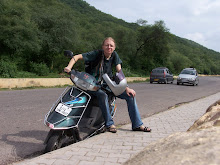
Well, I am done! I have just finished my exams, handed in my final projects, gave a long mokhik prastuti (oral presentation) in Hindi - and my academic year is over! What a great feeling! Exhausted and happy I am ready for a bit of holiday. Studying in India can be a challenge. Here in Jaipur we are lucky - the electricity runs smooth, so the fans can keep fanning us in the increasing heat of the desert. Still, heat is draining and mixed with stress and lack of sleep can be a hard thing to fight with. Sleeping on wet marble floor made me feel like a yogi...
Seems like Govindadev was on my side though! Everyday after unlimited hours in my samsthan (institute) I would just sit on my scooter and take myself to have darsan of the Lord (and His devotees too!). Jay Govindadevji!
Monday, April 21, 2008


Saturday, March 29, 2008
Varanasi
Last month my Mother came to visit me in India. Since I had a midterm break in my studies, we decided to 'hit the road' and see some places that were of interest for my Mom. We had a great time in Delhi, Vrindavan, Varanasi and Jaipur. So - here you go - a bunch of pictures from Varanasi!
 Varanasi - the city of lights, city that gives liberation, place for Gangaji worship, hippie paradise, cremation ghats and a good university - a blend of it all!
 Typical little, narrow gallies of Kashi. My Hindi teachers from here (Jaipur) are mostly Varanasi-vasis. They say that these little gallies were designed to be narrow like that on the purpose. In case of a Mughal army attack - not many soldiers could squeeze in such a narrow space all at once!


 Zorro in Kashi! Actually not, he was a French tourist, and I have no idea why he was always dressed like that! I have bumped into him on several occasions, within a few days.
 The Devatas and me!
 Gangaji.
 Famous Ganga arati at the Dasasvamedha Ghat.
 Here my Mother is ready to do her own offering too!


 Me loitering around on the grounds of the BHU - Benares Hindu University. They have a great campus with many department buildings. Some years ago I was considering studying there, but somehow or other I ended up at SOAS in London instead.
 These riksha wallas are friends of my fellow students in Jaipur. 3 years ago our Hindi Language Program was based in Varanasi, before it was finally shifted to Rajasthan.
 Varanasi - the city of lights, city that gives liberation, place for Gangaji worship, hippie paradise, cremation ghats and a good university - a blend of it all!
 Typical little, narrow gallies of Kashi. My Hindi teachers from here (Jaipur) are mostly Varanasi-vasis. They say that these little gallies were designed to be narrow like that on the purpose. In case of a Mughal army attack - not many soldiers could squeeze in such a narrow space all at once!

 Zorro in Kashi! Actually not, he was a French tourist, and I have no idea why he was always dressed like that! I have bumped into him on several occasions, within a few days.
 The Devatas and me!
 Gangaji.
 Famous Ganga arati at the Dasasvamedha Ghat.
 Here my Mother is ready to do her own offering too!


 Me loitering around on the grounds of the BHU - Benares Hindu University. They have a great campus with many department buildings. Some years ago I was considering studying there, but somehow or other I ended up at SOAS in London instead.
 These riksha wallas are friends of my fellow students in Jaipur. 3 years ago our Hindi Language Program was based in Varanasi, before it was finally shifted to Rajasthan.
Thursday, March 27, 2008
Holi in Jaipur
I have spent whole Holi period in Jaipur, though almost every day all my Brajbasi friends from Varsana and Vrindavan were calling me on my phone asking me to come to Vraj. Well, as much as I wanted to go - I couldn't due to my upcoming exams.
Jaipur was full of festivities though! Every day in Govindaji mandir from 12pm up to 5 pm, various artists from all over India were singing Holi bhajans, while people would play with colors in the middle of the courtyard.
Jaipur was full of festivities though! Every day in Govindaji mandir from 12pm up to 5 pm, various artists from all over India were singing Holi bhajans, while people would play with colors in the middle of the courtyard.
 Local market stalls in front of the temple and all over the city, offered variety of colors and pichkaris.
 Here are a few shots of Govindadevji. An evening one. Lokanath Swami was giving Bhagavat Katha for one week in a pandal program just behind Govindaji temple (in Jai Nivas Gardens). I took this picture while I was having last darsan before heading off home after his class.
 Govindadev in a festive mood!
 And Radharani with a pichkari.
 For 3 weeks before Holi, every day, Radha Govindadev were wearing a new outfit, made out of gulal - powdered color used in Holi play.
 Gaura Purnima darsan. During the day there was also an abhisek of Lord Gauranga. Festivities related to Mahaprabhu's jayanti will continue in Jaipur all the way up to June. They will include harinam-sankirtan processions, special bhajans, katha from "Caitanya-caritamrta" and a competition for school children and students who will speak on life of Mahaprabhu.
 The main Holi festival consists of 2 days. On Friday everyone played Holi in the temples. On that day on the evening, all over the city people burn big fires, perform puja and symbolically burn in it all the bad things that they would like to get rid of in their lives. This photo was taken on a road leading to Radha Gopinath mandir. Within this area people are quite traditional and very religious; it is a sweet community. So there I was - braving all the smoke and fires, zigzaging in between it on my scooter!
 Saturday was the second day of Holi. On this day everyone plays Holi on the streets. Great fun! Here we are with the whole gang of Hindi students. Great highlight for us girls - we could freely attack all local boys who were passing by on their motorbikes and we could take a colorful revenge for all the trouble they give to all girls on the daily basis.
 Here I am under the attack!
 And this is how I looked after local kids splashed on me 5 buckets of water.
 Jaipur held also an annual Elephant Festival, which falls on the purnima day. Folk dancing, elephant races and beauty contests were the highlights of the event. Enjoy the rest of the photos!


Saturday, March 15, 2008
Hindi Shivir in Pushkar
Recently I went for a few days to Pushkar – for a Hindi Shivir (Hindi gathering), which was organized by my school in Jaipur. All teachers and all students were present there, students attending Hindi course in Delhi
Pushkar is famous for it’s

Pushkar has certainly a spiritual atmosphere and it has it’s unique twist. Due to the influx of videshi tourists (mostly from


The sacred lake created by Brahmaji. Whoever takes bath here will go to heaven and will never be born again in the material world.
 Every evening an arati is performed on the ghats of the lake.
Lord Brahma.


Group of ladies from


My teachers – Rashmiji and Anitaji.

My teacher – Nilamji - presents the sum and substance of Indian existence – chai (tea) and snacks!

Nilamji, Zain and me are ready for a rocking kirtan!

Here I am getting my homework done – translating Hindi into Marvar – a rajasthani dialect.

 The color of Rajasthan!
I also made friends with some local artists.
Wednesday, February 13, 2008
Winter holidays part 3 - Shimla
 Here are few shots from my stay in Shimla. Until the British arrived, there was nothing in Shimla except a sleepy forrest glade known as Syamala (name for Kali). When the Scottish civil servant Charles Kennedy build a summer house here in 1822, everything has changed. By 1864 Shimla has developed into the official summer capital of the Raj. Every summer, until 1939, the entire government of India stayed here in order to escape the heat in other parts of Bharat. Until 1966 Shimla was even briefly a capital of Punjab.
 My fellow travellers - Sarah from Vrindavan, Micheal from Chicago and Louise from London, who both study Hindi with me in Jaipur. We are relaxing after visiting the Jakhu temple, which is dedicated to Hanuman. Monkeys are certainly present there and one has even bitten Micheal.
 At the time of our stay, the local voting poll was going on. I stepped into the BJP rally, waved to the politicians and got an ashirvad in return. BJP won.
 Views which daily soothed my "over-studied" mind!
 Christ Church built between 1846 and 1857. Since it was Christmas time when I visited this beautiful town, members of the Christ Church community were busy entertainig tourists with Christmas carrols and food distribution (rice, subji, chapatties - in case you wandered!)
 Shimla certainly feels like England!
 Shimla hundred years ago.
 Viceregal Lodge - an important historical spot, since it is here where the decision of the indian partition was made. Gandhi and Nehru were of course present in the meetings. Nowadays this beautiful building is used as the Indian Institute of Advanced Study and a museum. British emblems were removed and replaced with Indian national emblems.
Subscribe to:
Posts (Atom)